
A financial firm can approve every asset in a campaign and still lose control of the campaign. A carefully qualified line in a white paper turns into an absolute claim in a paid ad. A webinar registration form feeds a follow-up sequence nobody reviewed. An executive reposts an approved article and adds a comment that changes what it says.
Each of these is a coordination problem with compliance consequences. They happen when a financial firm governs individual assets while its marketing runs across connected channels.
I think marketing leaders need to own more of this. Compliance sets the boundaries and makes the calls within its authority. But marketing makes most of the day-to-day choices that uphold those boundaries.
A good governance framework puts those choices on paper before a campaign launches.
What Is a Marketing Governance Framework?
A marketing governance framework is the documented system that a firm uses to assign decision authority and control marketing throughout its lifecycle. It ties campaign planning to the firm’s compliance obligations, including the evidence that required controls operated properly.
Inside that system sits a marketing risk framework, which looks at what could go wrong and matches controls to the exposure.
Governance settles who makes a decision. Risk assessment settles what the decision has to cover.
For an integrated campaign, the framework must follow the whole audience journey, including what happens after someone clicks an ad or attends an event, as well as any content outside partners distribute.
A note on scope: I’ve written this for U.S. investment advisers and broker-dealers. Banks and insurers will need to adapt it. The steps below are management practices I recommend, not a restatement of the rules, and which rules apply depends on the firm’s activities and registration status.
Step 1: Map the campaign and identify which rules apply.
Start with the basics: which entity is behind the campaign, what service it promotes and who it’s meant to reach. For a single-entity RIA, that first question takes seconds. For dual registrants, hybrid practices and firms with affiliated broker-dealers, insurance agencies or fund entities, it decides which rules apply. Then map every planned communication and the action it asks people to take.
For a webinar, that means a lot more than the slide deck. The map should include the invitation, the registration page, any paid promotion, the live discussion, the replay and the sales follow-up. If there’s a co-sponsor, note what they’re doing and where attendee information ends up.
Now compliance has something concrete to classify.
For advisers registered or required to register with the SEC, the SEC’s Marketing Rule governs communications that meet its definition of an advertisement. It includes general prohibitions against misleading advertising and specific conditions for content such as performance and compensated endorsements. Labeling a piece “educational” doesn’t settle whether the rule applies.
For FINRA member firms, Rule 2210 distinguishes correspondence from retail and institutional communications, with different review requirements. Retail communications generally need approval from an appropriately qualified registered principal before use, with some exceptions, and certain communications must also be filed with FINRA.
Dual registrants need to be clear about which entity is speaking and which requirements govern each asset.
Every firm also needs to look at who will actually receive each piece. Several rules depend on the audience. FINRA treats an institutional communication as retail if the firm has reason to believe it will reach retail investors. The Marketing Rule requires hypothetical performance to be relevant to the intended audience. And private fund offerings may be limited to accredited investors. When the rules depend on the audience, the brief isn’t enough. Restrict distribution with vetted contact lists, gated pages and ad targeting settings, and check where the asset ends up after launch.
Step 2: Assign decision authority before assigning deadlines.
“Send it to compliance” isn’t an operating model. It leaves too many questions open.
Who verifies the product claim? Who checks what the registration form collects? And who confirms that the version that went live is the one that was approved? Those are often three different people, and none of them may know it’s their job.
Name one accountable campaign owner. Then spell out which decisions everyone else owns.
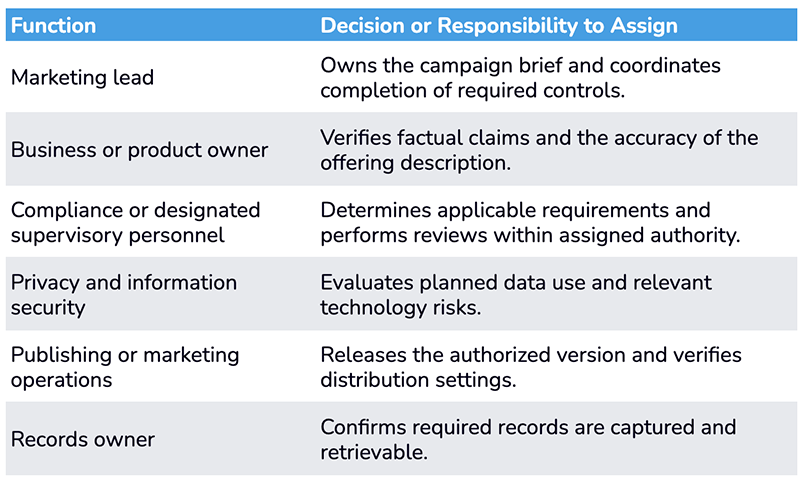
Smaller firms can combine roles, but they still must name the person holding each one and keep any required qualifications or supervisory separation intact.
For broker-dealers, this allocation must fit the firm’s supervisory system. FINRA Rule 3110 places final responsibility for proper supervision with the member and requires written supervisory procedures. An outside agency (including one like ours) can help carry out the work, but it can’t take on that regulatory responsibility.
Also, every critical decision needs a backup owner. Decide in advance how disagreements get escalated to someone who can resolve them, and who has the authority to pause distribution. A launch date is never a substitute for approval.
Step 3: Assess risk and set a review path.
An office-move announcement and a campaign featuring investment performance shouldn’t sit in the same review queue as if they raise the same questions.
Instead, build a simple risk register. For each material way the campaign could fail, describe what would happen, the control meant to prevent or catch it, who owns that control and how much exposure is left once it’s in place.
Here’s a failure that’s easy to miss: A firm runs a webinar on a private credit fund for accredited investors only, with registration gated behind an eligibility question. A few weeks later, the replay goes up on the public Insights page because that’s where every webinar replay goes. The brief said “accredited investors.” The brief said “accredited investors,” but nobody publishing the replay was asked to check who it was for. A label in a brief won’t prevent that. Access restrictions and a distribution check before anything goes live will.
Then use the assessment to pick a review path:
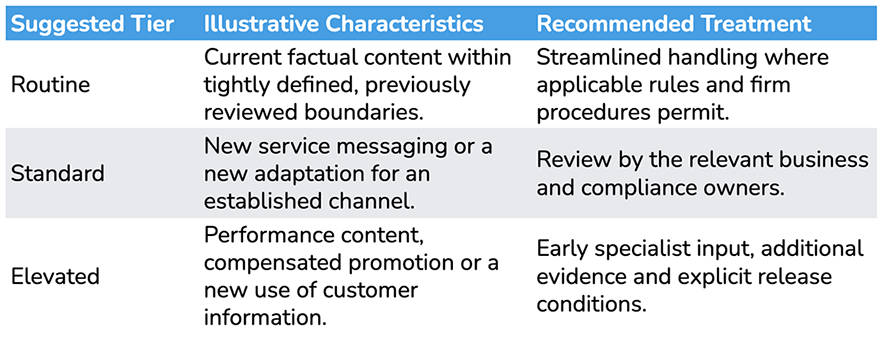
These tiers are merely internal planning tools. Calling something “routine” doesn’t remove a mandatory approval or filing requirement.
Watch for a serious problem hiding behind a low overall score. If nobody has confirmed whether a campaign can reach a particular audience, hold the launch, even if everything else checks out. Write down why, so the next team facing the same question has something to go on.
Step 4: Build a claims and disclosures system.
If your team reuses the same claims across campaigns, keep a shared reference document showing which language has been reviewed and the conditions for using it. Without one, reviewers keep re-checking familiar wording, and marketers assume a line approved for one purpose works everywhere.
For each recurring claim, store the supporting evidence alongside guidance on where and how to use it. Give someone ownership of keeping it current, with a review date that forces the question of whether the statement is still true. Link each claim to its required disclosures, when they apply and which edits would trigger another review.
The evidence matters because examiners will look for it. The SEC’s 2024 Marketing Rule risk alert described exam findings involving unsubstantiated statements of material fact, misleading implications and failures to present material risks or limitations fairly. Also, reviewers can’t judge whether a claim holds up if they can’t see what actually supports it.
For example, a case study shows that one client cut trade reconciliation breaks by about a third in the year after adopting your service. That can support a carefully qualified statement about that client’s experience. It doesn’t support “reduces operational risk” on a banner ad. Record those limits in the library so writers can adapt the language without stretching it past the evidence.
Carry that care through to the finished asset. A disclosure that’s easy to read in a Word draft can shrink to nothing on a phone or disappear when a video gets cut down. Review disclosures in the format the audience will actually see and let compliance decide when information must appear in the communication itself instead of behind a link.
Step 5: Make approval specific to the version and its use.
An approval only means something if everyone knows exactly what it covers. Give reviewers the finished asset in its real format, the source material behind its claims and enough campaign context to judge it: who it’s for and how it connects to the other communications. If distribution settings are part of what restricts the audience, put those settings in front of reviewers too.
Once something is approved, record the approval against that specific version and any conditions on its use. Keep a reviewer’s request for changes separate from final sign-off and make someone responsible for confirming the revised asset meets those conditions before it’s published.
Your team also needs to know when an edit triggers something to be sent back for review, because small changes can shift what a communication says or which rules apply. A common version: A reviewer approves “strategies designed to help manage downside risk.” Then the social team, wanting something punchier, posts “Protect your portfolio from the next downturn.” Same idea, very different promise. Trimming a webinar clip can strip out the context that made it acceptable. Sharing the same piece with a new audience might require a fresh look.
For broker-dealers, this ties directly to FINRA Rule 2210’s approval and recordkeeping provisions, which require firms to retain the communication along with specified approval or preparation information. Linking the authorized version to its review record lets you show what was approved and how it was used.
Build review time into the schedule before you commit to a launch date. Agree on turnaround targets that start when reviewers get a complete submission, not a draft with placeholders, and decide how urgent requests reach the right decisionmaker. That keeps deadlines manageable without skipping required reviews or publishing anything before it’s signed off.
Step 6: Review the data journey alongside the content.
If a campaign collects or uses personal information, reviewing the copy is only half the job. Before launch, trace what happens to someone’s information from their first interaction through every follow-up. A registration form might feed your CRM, but it might also kick off an automated email sequence or hand attendee details to an event partner. Each of those uses belongs in the review.
Start with whether you need the information at all. Someone signing up for a newsletter has made a different choice than someone asking for advice, and the form should reflect that. Your team should also know where the data goes and who can see it, and privacy and security owners should weigh in before anyone turns on unfamiliar tracking or uploads an audience list to an ad platform. A privacy notice on its own doesn’t make a particular use permissible.
These decisions also have to fit the firm’s broader safeguards. For covered institutions, the SEC’s amended Regulation S-P requires incident response procedures and service-provider oversight for customer information. Both compliance deadlines had passed for firms of all sizes by June 3, 2026, so marketing technology that handles covered information should already be connected to the firm’s safeguards and incident response process.
Understand how email distribution handles recipients’ choices. CAN-SPAM covers business-to-business commercial email, not just consumer email, and requires accurate sender information and a working opt-out. Opt-out requests must be honored within 10 business days. Hiring another company to send the email doesn’t relieve the promoted company of responsibility.
Finally, test it across every system involved. Here’s how it typically breaks: A prospect unsubscribes from the firm’s newsletter on Monday; on Wednesday, a sequence an advisor built in the CRM sends “Following up on last week’s webinar.” The email platform did its job. The CRM never heard about it. Decide who is responsible for those preferences across the campaign, and have the right reviewers check any additional consent or privacy requirements for the audience and jurisdiction.
Step 7: Design recordkeeping before launch.
Prior to launch, settle how the firm will preserve what it sends and the evidence behind it. Saving the final PDF might cover one asset, but not the social posts that promoted it or the emails that followed. Someone outside the project team should be able to see what reached the audience and trace meaningful changes without relying on anyone’s memory.
Work with compliance to determine what each communication requires. SEC adviser recordkeeping requirements include copies of advertisements disseminated directly or indirectly, with additional requirements for certain content. FINRA member firms have their own communications recordkeeping obligations, including retention periods and the format in which records must be kept.
From there, build a retention schedule by record category, and make someone responsible for confirming the capture actually works. Records from the same campaign might need different treatment, and routine deletion must make room for legal holds.
Pay close attention to where conversations go once people respond. A prospect replies to a LinkedIn ad with a direct message, and the advisor answers from his phone over the weekend. FINRA has explained that digital recordkeeping obligations depend on the content of a communication, not the device or technology used to send it, so your procedures must cover those exchanges.
The most useful test I know: Pick a finished campaign and rebuild it using only the retained records. Can you find what went out and connect it to its review and supporting evidence? Screenshots help show how content looked, but the capture process must also preserve the context and records the firm needs. If rebuilding the campaign means searching someone’s inbox or asking what happened, you’ve found a gap.
Step 8: Control what happens after publication.
Once a campaign is live, someone must confirm the audience is seeing what the firm approved. That’s the campaign owner’s job, and it includes scheduled posts and automated follow-ups that keep running long after launch. Decide who monitors responses and routes complaints through the firm’s existing process.
Live events need extra attention because the conversation can wander past anything reviewers saw. Brief speakers on the boundaries and how to handle questions they shouldn’t answer on the spot. Before you distribute a replay, review what was actually said. Approving the slides doesn’t approve every comment made during the Q&A.
The same goes for repurposed content. A portfolio manager on an approved webinar says a strategy has historically held up better when rates rise, then spends two minutes on the periods when it didn’t. The social team clips the first 20 seconds and captions it “Built for rising rates.” The webinar was approved. The clip is a different communication, and it needs its own review before it goes anywhere.
When a problem turns up after publication, the team should already know who can pause distribution and who decides whether a correction or notification is needed. That process must reach every connected channel so an outdated claim doesn’t keep running in an email sequence after someone fixes the landing page. Preserve the evidence before changing or removing anything, consistent with the firm’s obligations, and document how the issue was resolved.
Step 9: Measure whether the framework works.
Where a campaign gets stuck tells you more than any policy review. If the same claim keeps coming back from compliance, the problem probably starts well before review. Maybe the writer never got the supporting evidence, or the guidance leaves too much room for interpretation. Track that pattern and you have something specific to fix, instead of just asking everyone to move faster.
Approval times help as long as you look past the numbers. A fast turnaround means little if what was published doesn’t match what was approved. When marketing and compliance review a finished campaign together, they should be able to follow each decision through to the final communication. Wherever the trail goes cold, fix the process there.
The people who did the work can tell you why a procedure was hard to follow, and a workaround often points to an unclear responsibility or a tool that can’t do what the process assumes. Once you agree on a change, give someone ownership of it and check whether it worked on the next campaign.
In its September 2026 risk alert on adviser annual compliance reviews, SEC examination staff pointed to gaps between written policies and actual practices, and to issues firms identified but never resolved. A review is only worth doing if it leads to changes the team can show in its work.
What to Keep on File
Each step leaves part of the paper trail. Here’s the full set:
- Campaign inventory. The responsible entity and audience for each asset, with compliance’s classification and any filing deadlines.
- Decision matrix. Who holds each authority and how unresolved questions get escalated.
- Risk register. Who owns each control, the review path and any unresolved launch conditions.
- Claims and disclosure library. Permitted uses for each claim and who keeps the guidance current.
- Approval records. Each approval tied to the authorized version and its permitted use, with guidance on which changes need another review.
- Campaign data map. Where personal information goes, how it may be used and who is responsible for access controls and suppression.
- Retention schedule. Clear capture responsibilities, backed by a retrieval test showing the campaign can be rebuilt from its records.
- Monitoring and correction plan. Who watches live campaigns and who can stop distribution and authorize a fix.
- Improvement log. Recurring problems, the changes made to address them and whether those changes worked.
Put the Framework Into Practice
You don’t need to roll out your entire framework all at once. Start with a campaign already on the calendar; ideally one that crosses teams, like a webinar promoted through email and social media. Pick something with enough lead time to fix what you find before it launches.
First, sit down with the people running it and walk through the campaign in the way they would actually work it. If marketing wants to turn a webinar excerpt into a social post, who decides whether it needs another review? Work through questions like that with the risk assessment in hand, and you’ll settle who owns each decision and where reviews belong in the production schedule.
As production gets going, have the team use the claims library and record approvals as they go. Submit a test registration and see where the data lands. Check that the archive is capturing what you expect. If either test turns up a gap, you still have time to close it before launch.
After the campaign wraps up, try to rebuild it from your records. If you have to ask the campaign manager which version went out, fix that before rolling the process out more widely. Give the pilot about three months if your schedule allows, but don’t wait that long to close known compliance gaps.
Then, if needed, you can use what you learned to drive your software decisions. Your project management system might already move work between marketing and compliance just fine. Once you’ve seen where the process breaks, you’ll know whether you need tools to preserve required records or to make sure the right person signs off before anything is published.
Financial Marketing Governance FAQs
Who should own marketing governance at a financial firm?
Ownership is shared, but each role should be specific.
- An executive sponsor gives the framework authority, resolves disputes between teams and approves the resources it needs.
- A marketing owner runs it day to day: managing the campaign process, making sure required controls are completed, and keeping the claims library and records current.
- Compliance determines what the rules require and reviews or approves within its designated authority.
- Business and product owners verify that factual claims are accurate.
However the roles are split, the allocation has to fit the firm’s regulatory obligations. A marketing title doesn’t carry supervisory qualifications.
Does every marketing asset require compliance approval?
It depends on the rules that apply to your firm and the communication, as well as your internal policy. Document the review path for each category of content. You can choose to be stricter than the regulatory minimum, but make that a deliberate choice and write it down.
Can approved content be reused across channels?
Yes. However, you should treat an approval as permission for a defined use. Reuse within those conditions is fine if it follows your procedures. But a new format or audience can change the communication, so an adaptation might need its own review even when the source was approved.
Can AI help with marketing governance?
Yes, within limits. AI is good at mechanical checks like comparing versions or flagging missing fields. Give it a defined role, have a person verify its output, use only tools approved under the firm’s data policies and keep decision authority with people.
Make Governance Part of Campaign Planning
Here’s the test I apply to any marketing governance framework:
Pick a campaign from last quarter. Can your team explain how it went from an idea to a message in someone’s inbox, and prove it from the records without asking anyone what they remember? If not, start there.
When ownership is settled early, marketing can plan around real requirements instead of discovering them at the last minute. Reviewers get work they can actually assess, and the team has a way to handle changes after launch. That holds up far better than depending on a few experienced people to remember every exception.
If your campaigns keep stalling at the same handoffs, bring Mischa Communications into the planning process. We’ll help you build a marketing workflow that fits your compliance requirements.